
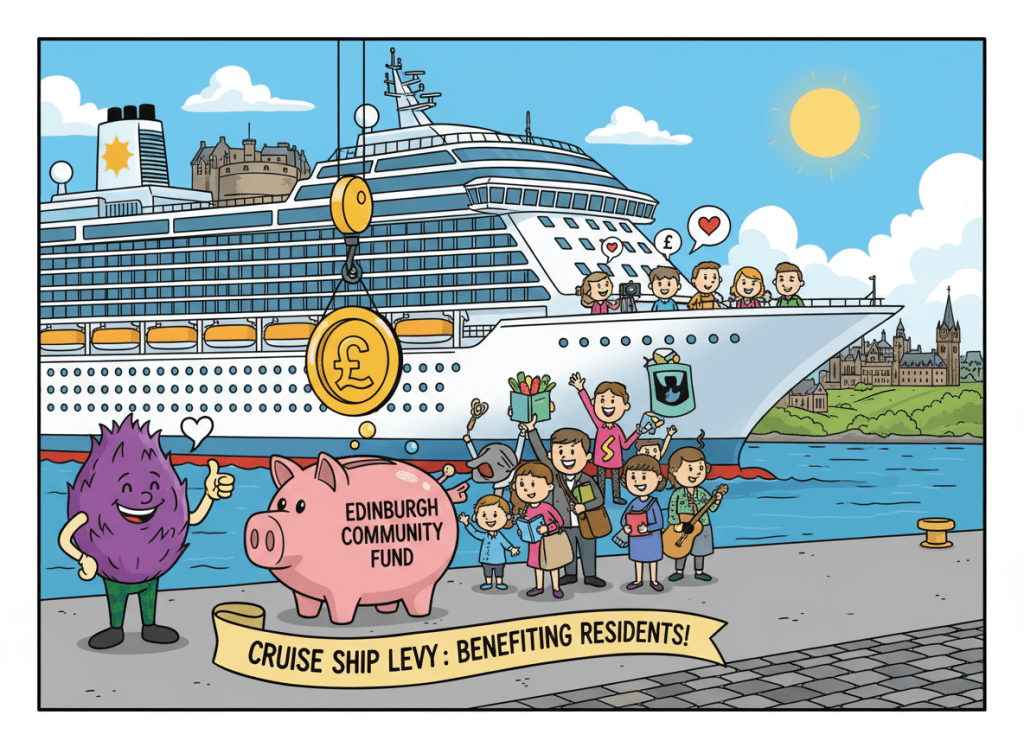
Now that Labour has introduced a Tourist Tax in Edinburgh, after years of campaigning for the power, people are asking why it doesn’t apply to cruise ships. Each year, around 217,500 cruise passengers visit Edinburgh and the surrounding region, with many docking at Leith, Newhaven, and South Queensferry.
To explore this, I asked the House of Commons Library for an assessment of cruise ship levies. Their briefing focuses on Iceland, often cited as an example where such a levy exists.
The key finding is that a handful of other cities, such as Lisbon, Amsterdam, and Barcelona, have introduced cruise ship levies, typically managed by local authorities rather than central governments.
Iceland applies a levy to domestic cruise ships docking in its ports. It does not apply to international ships or vessels in distress.
So far, the impact of Iceland’s levy is unclear due to limited data, though media reports suggest a negative effect on the cruise sector.
Cruise ship levies
You asked for details about Iceland’s “daily infrastructure fee” applying to cruise ship passengers, and about whether any similar proposals had been made for Scotland.
The following briefing addresses the five questions that you asked about the Icelandic system in turn. It then sets out developments in Scotland concerning cruise ship levies.
Basic information about the fee and how it works
Iceland operates a visitor levy of 400 kroner per day (£2.50) on camping and caravan sites, and 800 kroner per day (£5) on guesthouses and hotels. The former fee also applies to “an overnight unit for use on board a cruise ship in domestic sailings around Iceland”.[1] This levy was first introduced in January 2024. The legislation says:
An overnight unit refers to the rental of accommodation for up to one day, including overnight. Accommodation means accommodation or areas, including on board a cruise ship, which are rented out for the purpose of overnight stays, sleeping facilities are available or can be accommodated, and the rental is generally for a period of less than one month.[2]
The levy is payable whether or not the cruise ship actually docks at an Icelandic port, and regardless of whether passengers disembark from the ship.
A separate ‘infrastructure fee’ of 2,500 kroner (£15) per passenger per day is also payable. The crew and personnel of a ship are not included in the passenger count for the purposes of the infrastructure fee. Ships that dock in Iceland in distress or following “sea damage, illness or hostilities” are exempt. The cruise ship operator, not the individual passenger, is liable for the infrastructure fee, and it is payable regardless of whether the ship docks at a port or passengers disembark. The cruise ship operator must submit information on occupancy to Iceland’s Directorate of Internal Revenue.
International cruise ships are not liable for the visitor levy, and domestic (to Iceland) cruise ships are not liable for the infrastructure fee.
The infrastructure fee was introduced for the first time in January 2025, and it is this fee, rather than the visitor levy, which has generated recent commentary within the tourist industry (see below). A source on the news website RUV stated in September 2025 that the 2,500 kroner fee was to be reduced to 2,000 kroner ‘next year’.[3]
What success the fee has had – how much money raised, popular support etc
I have not been able to find any information about the amount of funding raised by the infrastructure fee. Internet sources quote the figure of £7.9 million / £8 million per year, but this appears to be the Icelandic government’s expected revenue rather than an actual figure. More information may become available when the fee has been in place for longer.
What its impacts have been on the cruise industry around Iceland
There are a number of reports on the impact of the infrastructure tax on the cruise industry, and on Iceland’s tourist economy. Most predict that the impact will be negative. I have been able to find very little information about the actual impact. I cannot guarantee how accurate the sources of information presented here are, or are likely to be.
One website quoted a local mayor as saying:
“The infrastructure fee on cruise ship passengers … [will still be] much higher than fees on other tourists. It is necessary to ensure predictability, as shipping companies plan far ahead. This change will simply cement this fee, which we are extremely unhappy with, because this means inequality in fee collection,” says [the mayor] in an interview with RÚV.
Municipalities in rural Iceland have unsuccessfully expressed concerns about a reduction in the number of ships, with the resulting effects on local tourism, and these are becoming reality. Cancellations have increased with the introduction of the fee.[4]
The website Cruise Industry News said in January 2025:
“The ports of Grundarfjörður, Vestmannaeyjar, Akureyri and Faxaflói have all reported cancellations, with the newly imposed fee cited as a reason. In Akureyri, there will be 44 fewer ship visits than last year, RÚV reported. Grundarfjörður has seen seven cancellations for 2025 and an additional 14 for next year. At least 10 fewer cruise calls are expected in Vestmannaeyjar compared to 2024.”[5]
This article quoted the chair of the organisation Cruise Iceland:
“We would have, first of all, wanted to see this implemented in stages so it wouldn’t hit operations as hard as it does now,” Sigurður Jökull Ólafsson, chairman of the organization, told the website.
In late 2024, Cruise Iceland is said to have warned the local government about the potential effects of the sudden imposition of a new fee legislation.
“It’s reasonable for this industry to contribute. But it must be implemented with adequate notice,” Ólafsson added.[6]
A report in October 2025 on the website EuroNews suggested that the increased levies had not reduced tourist numbers in Iceland:
However, data from Statistics Iceland show the number of foreign visitors increased by 2.2 per cent from 2023 to 2024, while the last 12 months to September 2025 have seen an additional 3.5 per cent spike.
From January to August this year, Iceland has welcomed 1.792 million international visitors, an increase from 2024 (1.743 million) and a significant jump from 2019 (1.597 million).
The first seven months of 2025 have also seen the largest number of booked rooms at hotels and B&Bs so far, while turnover in tourism-related sectors has been “especially high” from 2023 to 2025.[7]
This article also reports an analyst at the Icelandic Tourist Board as saying that:
“….these fees do not bring ‘large sums to the coffers of government’, and finding the connection between taxation and contributions to the sustainability of tourism can be difficult due to them being sent to the overall government budget.”
He adds that the current government is planning to propose a “considerably” higher tourism tax in the coming weeks.[8]
I cannot say whether this suggestion about a higher tourism tax is true. The tenor of the article suggests that this is a reference to Iceland’s visitor levy, not the infrastructure fee.
If the fee has caused any issues or if there are any restrictions or limits to it
See above.
Which other countries have a similar fee?
I have identified a small number of cruise ship levies. These are typically operated by local authorities in cities or islands, as opposed to central governments. I cannot say how comprehensive this list is.
- Lisbon launched a fee of €2 per passenger in January 2024. A single €2 is payable regardless of the length of the cruise ship’s stay.[9]
- Amsterdam charges €14 per cruise ship passenger per night.[10] This applies to all passengers except under-twos and crew members.[11] Amsterdam defines a cruise ship as “a seagoing vessel exclusively intended and used for the commercial transport of passengers undertaking the journey for the purpose of tourism, consisting principally of the sea journey itself”.[12]
- The Greek government introduced a cruise ship levy for certain ports in 2025. The rate is €20 per passenger for popular destinations such as Santorini and Mykonos, and €5 for other Greek ports, between June and September. 60% of the levy will be charged in April, May and October, and 20% during the other months of the year.[13]
- Barcelona operates a charge of €7 per passenger per day (€3 in 2023/24, €1 previously). In 2024 the mayor, Jaume Collboni, announced plans to increase this by an unspecified amount.[14]
- Dubrovnik operates a sliding scale of charges based on ships’ capacity, from £235 for ships with a capacity of 50-200 passengers to £4,692 for ships with a capacity of over 3,000 passengers. The funds are broadly hypothecated “for investment in transportation infrastructure that would improve the overall standard of Dubrovnik as a destination, including things like electric ferries and digital signs to the City’s popular tourist attractions. In the longer term the funds may be used to develop new roads, tunnels, or other urban design elements”.[15]
Additional detail on Lisbon, Amsterdam, Barcelona and Dubrovnik can be found in the Scottish government’s 2025 Cruise ship levy consultation.
Scotland: plans for cruise ship levy
The Scottish Government’s 2024/25 Programme for Government stated that it was considering powers to introduce one. One of its action points is to “Intensify work on designing a cruise ship levy and undertake the necessary public consultation”.[16] Four round tables with industry and local authority representatives were held in late 2024, in Edinburgh, Inverness, Kirkwall and Greenock.
The Scottish Government published a consultation on the subject in February 2025.[17] It said that:
The Scottish Government has not made a final decision on whether or not to give local authorities the power to introduce a cruise ship levy in their areas. This consultation paper discusses and seeks views on a number of practical questions about how any cruise ship levy in Scotland would best work. That is because such questions about the practical working of such a levy are a necessary part of considering such a levy. We are aware that a cruise ship levy in Scotland would be first such levy in the United Kingdom, and we will need to carefully consider market implications and the effect on local economies and communities of such a levy.[18]
The Scottish government would introduce the power for local authorities to introduce a levy, rather than a nationwide levy.
The consultation states that the levy would apply to ships carrying paying passengers “which give the passengers the option to disembark from the vessel onto the Scottish mainland or a Scottish island”. They would not apply to ferries or private boats.[19] The levy might be based on the number of passengers, the boat’s passenger capacity, or the tonnage of the boat.
The consultation also notes the option of hypothecation – that is, whether revenue from a cruise ship levy “should be used to support facilities and services that are used by such passengers or the cruise ship industry”.[20] Revenue from the Scottish visitor levy must be spent on “developing, supporting or sustaining facilities or services which are substantially for or used by persons visiting the …. area for leisure or business purposes”.[21]
Some additional information is included in a regulatory impact assessment that appeared alongside the February 2025 consultation.[22]
[1] Icelandic Parliament, An Act amending various laws on taxes and levies, etc. (innovation, value-added tax, etc.)., 2024: see chapter IX, Amendments to the Act on Lodging Tax
[2] As above.
[3] Darren Adam, Fears over impact of infrastructure fee on rural Iceland, RUV, 10 Sep 2025
[4] As above
[5] Cruise Industry News, Cruise Ships Reportedly Cancelling Visits to Iceland Over New Fee, Jan 2025
[6] As above
[7] Liam Gilliver, Iceland to ‘propose’ higher tourist tax following record-breaking number of visitors, EuroNews, 15 Oct 2025
[8] As above
[9] See Port of Lisbon, Tourist Tax Collection in Lisbon for Cruise Passengers Starting in 2024, 20 Dec 2023
[10] Port of Amsterdam, Harbour dues and tariffs sea cruise
[11] Port of Amsterdam, Day Tourist Tax: everything you need to know
[12] Port of Amsterdam, General terms and conditions and rates of sea harbour quay buoy and dolphin dues Port of Amsterdam 2024, 2024, p8
[13] See Greek Travel Pages, Greece Rolls Out Cruise Passenger Levy with High Rates for Santorini and Mykonos, 16 Sep 2024
[14] Sky News, Barcelona set to ‘substantially’ raise tourist tax for stopover cruise passengers, 24 Jul 2024
[15] Scottish Government, Cruise ship levy: consultation, 27 Feb 2025, p36
[16] Scottish Government, Programme for Government 2024-25: Serving Scotland, 2024/25, p23
[17] Scottish Government, Cruise ship levy: consultation, 27 Feb 2025
[18] As above, p4
[19] As above, p10
[20] As above, p18
[21] Visitor Levy (Scotland) Act 2024, section 13 (2) and section 19
[22] Scottish Government, Potential local authority level Cruise Ship Levy in Scotland: partial business and regulatory impact assessment, Feb 2025

 Dr Scott Arthur