

I recently posted on my community Facebook page about persistent absence rates in schools. The stimulated a debate about the causes etc, but the Scottish does accept that “pupils with additional support needs had a lower overall attendance rate than pupils with no ASN (88.2% compared with 92.9%), a gap of 4.7 percentage points”.
Below is an independent and objective briefing from the House of Common Library on the issue.
Library response – Persistent absence rates
You requested data on persistent absence rates by nation, as well as some information on the cause of these persistent absence rates.
Your 2024/25 figures for Scotland (28.5% persistently absent) and England (18.7% persistently absent) accurately reflect the data published by the Department for Education and the Scottish Government. However, the data for England are estimates subject to later changes. The England data you cited is based on live, daily attendance submissions to the DfE by schools, and sometimes schools will amend their registers after submitting this point-in-time data. This live data also undergoes a weighting process to account for missing data. Definitive absence data for England for the 2024/25 academic year is due to be published in March 2026.
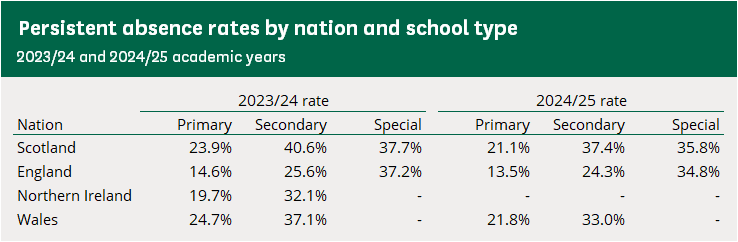
I have also provided the wider national breakdown data in the below table. As some nations do not publish an overall schools figure, and instead split this into primary, secondary / post primary, and special schools, I have done likewise.
Please note the following complexities which mean this data should be treated with caution:
- There are minor differences in the definition of “persistent absence” between nations. Broadly speaking, all nations define it as when a student misses 10% of their required classes. However, small differences exist, such as some nations define this in terms of missing a specific number of classes, and others define it in terms of missed half-days.
- Data from Northern Ireland has not yet been published for the 2024/25 academic year.
- In Wales, data is published based on the age of pupils rather than school type, meaning it is not possible to separate out data on special schools.
- Persistent absence data on special schools in Northern Ireland is not routinely published, and so this has not been included.
- Data on England in 2024/25 should be treated as an estimate rather than an exact figure, as discussed previously.
Sources:
Scotland – School attendance and absence statistics 2024-25, tables 4.3, 4.4, 4.5
Wales – Attendance and absence from primary schools 2024/25, Attendance and absence from secondary schools 2024/25
England – Department for Education, Pupil absence in schools in England, 2023/24, 2024/25
Northern Ireland – Attendance at grant aided primary, post primary and special schools in Northern Ireland – 2023/24
Factors driving persistent absence:
Regarding the factors driving persistent absence, education is a devolved issue and so the library does not have pre-prepared material on Scotland. However, I would point you to the following resources:
The Education Committee’s report on Persistent absence and support for disadvantaged pupils. While this again focuses on England, it may again contain relevant information for Scotland also.
The detailed data in the School attendance and absence statistics publication, which shows that persistent absence rates in Scotland are around 10% higher from 2022/23 onwards compared to 2010/11 to 2020/21.
The report Where have all the children gone? The school absence crisis sweeping Scottish schools, from The Centre for Social Justice Foundation. This suggests improving data collection, relationships between parents and schools, and creating attendance mentors as solutions to absence issues in Scotland.
The library briefing on School attendance in England. While this primarily focuses on England, some of the discussion may be relevant to Scotland also.

 Dr Scott Arthur