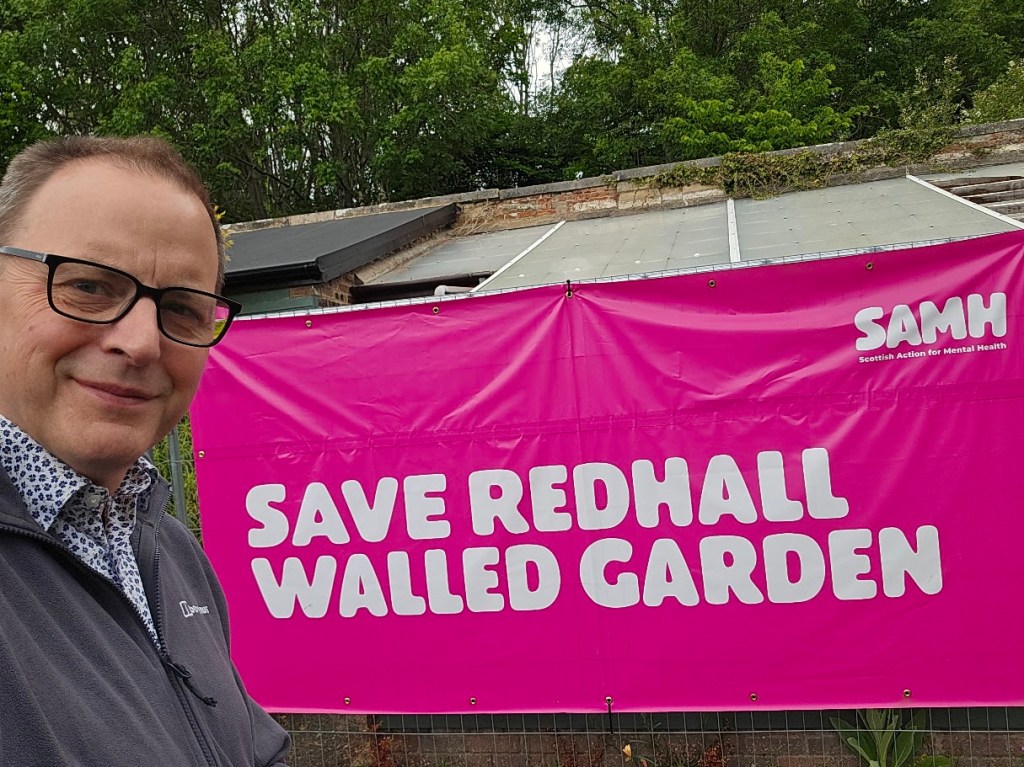
The threat to the existence of Redhall Walled Garden in Edinburgh South West has left some people wondering what exactly “therapeutic horticulture” is, and if there actual evidence that it works? Below is a briefing I requested from the fantastic people at the House of Commons Library on the subject!
Social and therapeutic horticulture
You have asked for “a briefing on the objectively assessed benefits of social and therapeutic horticulture, particularly for those faced with mental health problems or are recovering from drug/alcohol abuse.” Please find below stakeholder comment on this issue, followed by information on a House of Lords Committee report that references the use of horticultural therapy, and finally press releases and government-commissioned research that may be of interest.
1. Stakeholder comment
There are numerous reports that look into the use of horticultural therapy and green social prescribing to promote good mental health. Below I have summarised the findings of some key reports in this area.
1.1 A Handbook for Nature on prescription to Promote Mental Health
In 2021, the European Centre for Environment and Human Health and the University of Exeter College of Medicine and Health produced a handbook exploring the use of nature-based group activities for mental health and wellbeing (PDF). The handbook was produced as a contribution to the Nature on Prescription project, which was supported by the UK Research and Innovation’s (UKRI) Medical Research Council with involvement from the National Institute for Health Research.
The handbook says that gardening and horticultural therapy can provide the opportunity to gain accomplishment from caring and find belonging in a group. It states that reviews of gardening and horticultural therapy “noted significant findings for reduction of depression and anxiety, improved self-esteem and social function, improved mental and psychological well-being, improved cognitive function and better sleep/rest”.[1] The handbook argues that this is because horticulture provides participants with time to relax and reflect. Gardening is also often a “collective endeavour”; the handbook states that the community belonging it fosters can encourage more “Sustained engagement” from participants.[2]
Section seven of the handbook includes information on monitoring and evaluating nature on prescription. It notes that “high quality quantitative evaluation of Nature on Prescription (and social prescribing in general) is limited and is complicated by a number [of] factors”.[3] In particular, low numbers combined with the diversity of interventions being evaluated limits the robustness of evidence gathered. As well as this, there is limited evidence regarding the long-term impacts of interventions, which the handbook argues is reflective of short-term funding cycles. Further information about research methods and evaluation in this area can be found on pages 42-45 of the handbook.
1.2 National Academy for Social Prescribing
In March 2022, the National Academy for Social Prescribing (NASP) published a briefing on nature and health and wellbeing, summarising the findings of a review commissioned by NHS England.[4] The report did not look directly at therapeutic horticulture, but it did consider nature-based social prescribing interventions. Social prescribing is when healthcare professionals connect patients with non-medical, community services to help their health, wellbeing and social welfare.
The briefing summarised a range of articles, the details of which can be found in the briefing’s references section.[5] It concluded that there was evidence to show that time in nature was linked to “a range of positive mental and physical health outcomes”, including reduced levels of stress and social isolation, increased wellbeing and a decrease in post-traumatic stress disorder (PTSD) symptoms when time in nature was combined with therapeutic and mindfulness activities.[6]
The NASP said that further research was needed into referral pathways for green social prescribing, and that evidence focused on the use of green social prescribing to reduce health inequalities is lacking.
The briefing argued that “There is a large amount of evidence for the positive impact of green space on severe mental ill-health”, and that “holistic interventions”, including talking therapies and nature walks, can “help to prevent relapse and can increase peoples’ belief in their ability to achieve goals.”[7] Benefits in other areas, including loneliness and social isolation, were also highlighted.
Regarding reliability, the report stated that “The evidence base for social prescribing is relatively new and emerging”. Whilst most of the studies did show a positive correlation between accessing nature and health and wellbeing, the NASP said “it is not possible to conclude anything about the causality of these relationships” when determining which intervention could lead to health benefits.[8]
1.3 Loughborough University
In 2002, Loughborough University’s Centre for Child and Family Research published a literature review of research into social and therapeutic horticulture. It cites greater evidence for the benefits of horticulture on mental health than on physical health. The review also notes benefits for offenders and those recovering from substance misuse. Looking into why therapeutic horticulture provides these benefits, the review states that “The theoretical framework that underpins therapeutic horticulture relates to the ways in which landscape and nature can influence emotions, health and behaviour.” It concludes that research into the benefits can be sorted onto two categories – “attention fatigue and its restoration by the natural environment, and the role of the natural environment in recovery from stress.”[9]
1.4 The King’s Fund
In 2016, the King’s Fund published an independent report, commissioned by the National Gardens Scheme, on the benefits of gardens and gardening on health. The report is titled Gardens and health: Implications for policy and practice.
The report notes that increased use of green space “has been linked to long-term reductions in overall reported health problems”, and that access to green space can reduce the effects of income inequalities on health.[10]
Regarding gardening specifically, the report describes the mental health benefits as “broad and diverse”. It signposts to evidence of gardening leading to lower levels of depression and anxiety, but also notes that more research is needed to understand how these benefits come about.[11] The King’s Fund highlights four key areas in which gardening can be utilised in the health and care system:
- social prescribing,
- community gardens, volunteering and recovery from illness,
- dementia care, and
- end-of-life care.[12]
2. House of Lords Horticultural Sector Committee
On 6 November 2023, the House of Lords Horticultural Sector Committee published the final report of its inquiry into the horticultural sector, titled Sowing the seeds: A blooming English horticultural sector (PDF).
Pages 139-144 of the report consider nature-based solutions to ill health.[13] This section includes evidence from a range of stakeholders on topics such as social wellbeing, the reduction of stress, physical health and green infrastructure in urban settings. It cites a Royal Horticultural Society survey from December 2022, where 73% of respondents said gardening had a positive impact on their mental health. The committee points to increasing evidence for the mental health benefits of horticulture, but also notes that it is difficult to quantify these benefits due to the breath of possible influential factors.[14]
The committee concluded that:
The links between health, wellbeing and horticulture and green spaces more widely are broadly appreciated but there is more scientific research to be done to ensure we are making the most of our green spaces. Social prescribing and horticultural therapy programmes could provide significant benefits for those struggling with mental and physical ill-health and may reduce the burden on the NHS, but this must be properly resourced and regulated.[15]
A full collection of the evidence collected by the committee, including comment from the National Academy for Social Prescribing, can be found on the committee’s publications webpage.
3. Press releases, government publications and research
The reports below consider the use of green spaces and horticultural activities within social prescribing for health conditions. This includes considerations of NHS capacity to engage with green social prescribing and the benefits and challenges that the healthcare sector might encounter.
3.1 NHS England
NHS England has a webpage on green social prescribing, looking at green and blue (water-based) activities. The webpage states that “There is a strong and growing evidence that nature based social prescribing plays and important role in improving mental and physical health and reducing loneliness.”[16]
It also provides information and insights from the two-year Green Social Prescribing Programme which ran from April 2021 (further information below). NHS England’s findings from the programme include that:
- The programme led to “positive improvements in mental health and wellbeing”.
- There was 85% uptake of green social prescriptions.
- Communities with high levels of social inequalities affecting health and wellbeing showed “strong engagement”.
- The test sites involved in the programme have continued to provide green social prescribing, which NHS England says is demonstrable of “a lasting impact of the programme”.[17]
The NHS Forest website has a webpage on therapeutic gardens, which provides information on the use of gardens in NHS healthcare settings to support both mental and physical health conditions.
3.2 Government Commissioned Research
In 2020, the Department for Environment, Food and Rural Affairs (DEFRA), the Department for Health and Social Care (DHSC) and Natural England announced that £5.77 million was being invested into seven “test and learn” sites to evaluate the use of green social prescribing to address mental health conditions.[18] The research programme ran from 2021-2023. I have outlined findings from some government-commissioned research undertaken during the timeframe of the project below.
4. Exploring perceptions of grern social prescribing among clinicians and the public
In March 2023, the DHSC published Exploring perceptions of green social prescribing among clinicians and the public; the result of research carried out by IFF Research and commissioned by the DHSC.
Information was collected from a survey of 4000 patients and potential users of green social prescribing, a survey of 501 clinicians and qualitative interviews. It found that “the appetite for (green) social prescribing is high among both clinicians and the public.”
Regarding horticulture specifically, the IFF found that four in five clinicians felt “positive about horticulture type activities” for improving mental health. This included community gardening and food growing.
The report however noted that clinicians and patients are not aware of local services, and that clinicians “would value more information on the availability of specific services or activities in the local area to which they can refer patients.”
The report concluded that clinicians and the public were receptive to healthcare professionals playing a part in encouraging patient engagement in nature-based activities as part of a holistic care plan, which would include:
nature-based activities being offered at the right time to patients (when mental ill health symptoms are not too acute as patients are unlikely to be receptive to trying out a new activity when in crisis)
other options such as medication and/or therapy being considered alongside nature-based activity based on a discussion between the clinician and the patient
a timeframe being agreed for ‘trying out’ nature-based activity, with an invitation to return to the clinician if an improvement is not seen after this time[19]
5. National green social prescribing delivery capacity assessment
Alongside the findings of the IFF Research report, the DHSC published its final report of the National green social prescribing delivery capacity assessment in March 2023. The report looked at existing provisions of nature-based activities, with the aim of determining if provision was sufficient to support green social prescribing referrals. This report looked at provision in England.
The assessment includes a literature review looking at the benefits, system, capacity and equity of green social prescribing. It signposts to a report titled Gardening is beneficial for mental health: A meta-analysis, published in 2017, which found that gardening and therapeutic horticulture can aid in the reduction of depression and anxiety.
The assessment also looked into the use of green social prescribing for people with mental health needs. It found that utilising green social prescribing to promote mental wellbeing could be limited by capacity and lacking expertise of service providers:
GSP [green social prescribing] has the potential to both promote and restore mental health and wellbeing. Many link workers and green activity providers have at least some training that equips them to work with people who have mental health needs, especially those whose needs are mild to moderate. However, there are other capacity issues that undermine the ability of link workers and green activities to provide meaningful support to service users with mental health needs, particularly those with more severe or complex needs.
There is a worrying pattern of link workers and green activity providers receiving patients with complex mental and physical health conditions that they are not equipped to work with. In effect, these could be considered to be inappropriate referrals. Compounding this issue, we found that providers and link workers lacked specialist support for people with moderate to severe mental health needs. This can result in a situation that is unfair and risky for these service users while also placing unfair demands on link workers and green activity providers.
Rather than GSP being integrated into the NHS in England in a way that enhances overall care, there is a danger it instead acts as a holding system for service users who require more specialised support. Improving awareness within the health sector of the levels of need that social prescribing caters for, while increasing the availability of more specialised support services, would help to reduce numbers of inappropriate referrals.[20]
6. References
- [1] European Centre for Environment and Human Health and the University of Exeter College of Medicine and Health, A Handbook for Nature on prescription to Promote Mental Health (PDF), 2021, p31
[2] As above, p31, p36
[3] As above, p42
[4] National Academy for Social Prescribing, Evidence: Nature, March 2022
[5] National Academy for Social Prescribing, NSAP Briefing Natural Environment (PDF), March 2022, pp5-13
[6] As above, p1
[7] As above, p3
[8] As above, pp4-5
[9] Loughborough University, Centre for Child and Family Research, Social and Therapeutic Horticulture: evidence and messages from research, December 2002
[10] The King’s Fund, Gardens and health: Implications for policy and guidance, 17 May 2016, p6
[11] As above, p6
[12] As above, p7
[13] House of Lords horticultural Sector Committee, Sowing the seeds: A blooming English horticultural sector (PDF), 6 November 2023, pp139-144
[14] As above, p140
[15] As above, p143
[16] NHS England, Green social prescribing (accessed 12 June 2025)
[17] As above
[18] Department for Environment, Food and Rural Affairs, Department of Health and Social Care and Natural England, New sites to test how connecting people with nature can improve mental health, 19 December 2020
[19] Department of Health and Social Care, Exploring perceptions of green social prescribing among clinicians and the public, 30 March 2023
[20] Department of Health and Social Care, National green social prescribing delivery capacity assessment: final report, Conclusion, 30 March 2023

 Dr Scott Arthur