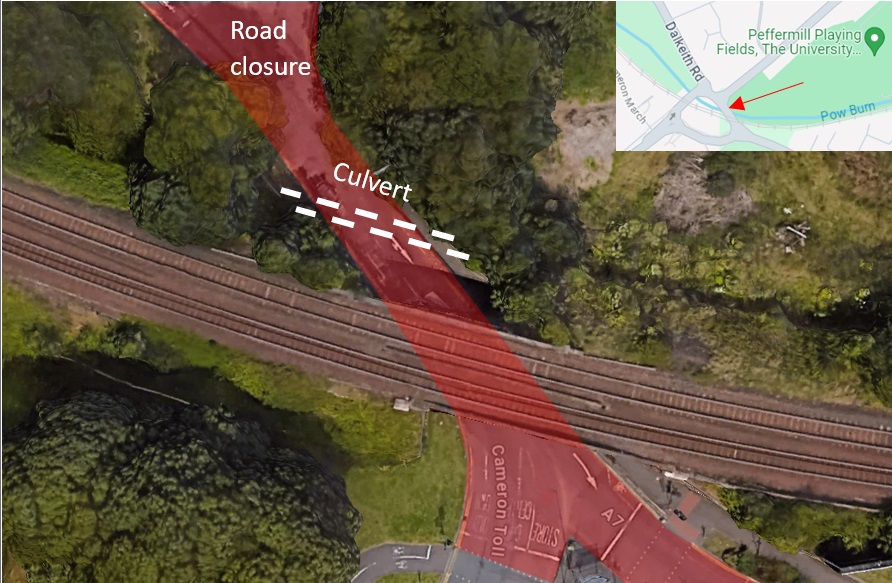
Below is a briefing from Council Officers on the collapsed culvert at Cameron Toll. It looks like the road will remain closed until the 10th of May.
Introduction
On 13 February during an unrelated inspection of the rail bridge, a partially collapsed culvert was identified below the road near Cameron Toll Railway Bridge and this has required closure of the roundabout between the Peffermill Road and Old Dalkeith Road arms of the roundabout.
The culvert carries the Pow Burn below this part of the roundabout and spans 3.6m. Most of the culvert is masonry and believed to be more than 200 years old, but under the footpath and central roundabout verge are concrete sections which were constructed more recently.
Exploratory works were immediately undertaken on the day of the collapse to expose and inspect the remaining structure. Due to the condition of the remaining length of masonry culvert, localised repairs would not be economical, and likely result in further regular disruption.
A decision has therefore been made to replace the masonry section of culvert, a 10m long section running approximately between kerb lines.
Progress to date
Multiple utilities (including a water main, sewer and communications cables) cross over and through the culvert which makes its replacement more challenging. The culvert is also in the vicinity of the Cameron Toll Railway Bridge and railway embankment, and therefore approval from Network Rail is required for the works.

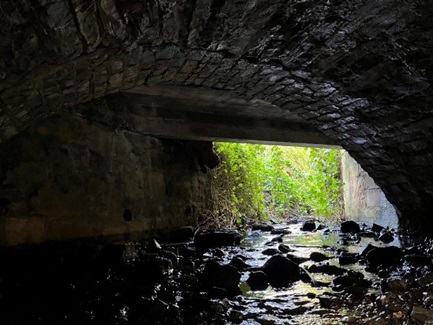
Utility pipes running through culvert Pow Burn below roundabout
A contractor has been appointed and precast concrete culvert sections have been sourced. Proposals have been submitted to Network Rail and their approval is awaited. Some in-situ concrete work to facilitate the services and tie the new culvert into the existing concrete sections is required, and a designer has been appointed for this aspect.
Traffic Management remains in place which diverts vehicles via Peffermill Road, The Wisp, and alternative signed routes.
The Council has already utilised the emergency closure to replace some road gullies on the roundabout, and subject to the programme for the culvert replacement, may also be able to undertake additional surfacing works.
Next steps
The contractor, Story Contracting, will be mobilising on site on Monday 4 March. Due to the Network Rail approvals and material lead-in times, an earlier start date would just result in unproductive standing time.
The works will then involve the following, utilising some weekend and night working:
- Installing over pumping equipment to divert and pump the watercourse over the road, to create dry working conditions.
- Removal of the remaining masonry culvert.
- Preparation for installation of the precast units, then installing these (weighing over 6 tonnes each) using a crane.
- Creating the in-situ concrete sections by installing formwork, reinforcing steel bars, and pouring concrete, in multiple stages to work around the services. This is one of the smallest parts of the job, but one of the most time consuming due to the concrete curing periods.
- Backfill, reinstatement and resurfacing, in advance of re-opening of the road.
The footpath adjacent to the site is currently open, however as the culvert passes under this footpath, it will need to be closed for most of the duration of the works, and pedestrians will be required to walk around the other side of the roundabout to travel between Peffermill Road and Old Dalkeith Road.
Re-opening
The works are expected to take up to 10 weeks, resulting in the road re-opening by Friday 10 May. The team will endeavour to improve on this date due to the recognised importance of this route, however it is vital that a well-engineered solution is constructed safely.

 Dr Scott Arthur