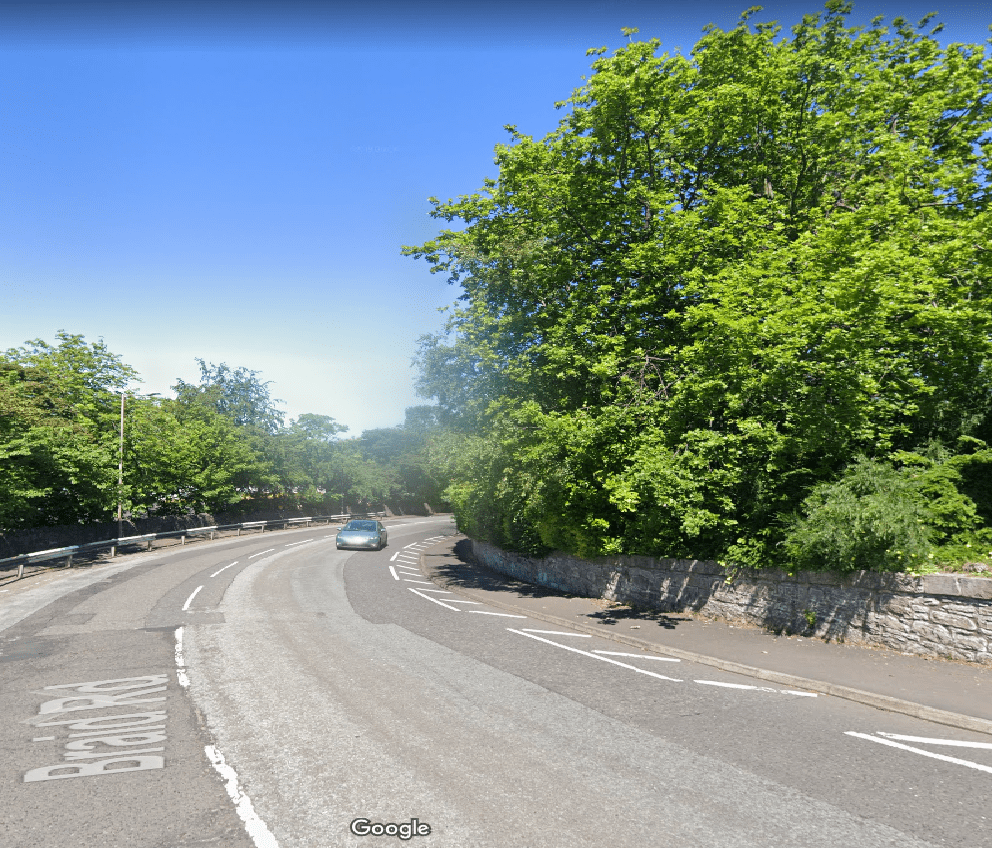
Below is a briefing on why Braid Road is opening to southbound vehicles. I’ve asked for this to be updated by the SfP team to respond to the following questions:
- Is it not incorrect to suggest traffic on Braid Road is zero? It’s on my running route, and there are still a lot of vehicles using the southern end to access Braid Hills Drive. Certainly not 9,486, but I expect there are still thousands of vehicles per day using Braid Road either side of the closure.
- Can the air quality results be explained? The LEZ proposed by the Council is based on the premise that fewer vehicles will result in improved air quality.
- It is noted that Lothian Buses have expressed support for reopening the road southbound. Were they asked about reopening the route to northbound traffic? Can northbound bus transits time data also be shared?
- Can it be confirmed who provided the “anecdotal” cycle use data for Braid Road?
- No explanation or justification is given for the continued closure of Braid Road. I normally run through the Hermitage 2-3 times a week as part of a longer circuit, and normally see around 10-20 people between Braid Road and Kirk Brae – a distance of around 2.7km. Sunday mornings are busier (maybe 30-40 people), but there are no issues with social distancing at the Braid Rd entrance. Ironically, the inadequate footpath at the Kirk Brae end (see image below) actually causes more issues. Does this observation align with your data? If so, would a more proportionate response not be simply to widen the footpaths at both the Kirk Brae and Braid Road ends?

Briefing on Braid Road
Introduction
A section of Braid Road was closed to all traffic between the junction of Braidburn Terrace and the Braid Hills Hotel in May 2020 to provide safer pedestrian, cyclist and wheeling access to the Hermitage of Braid park.
During the period of the closure the Spaces for People (SfP) team have on a regular basis considered the impact of the road closure on adjacent routes, the possible negative impact on air quality on Comiston Road and any delays experienced by Lothian Buses on the A702 routes.
This briefing note is intended to provide information gathered as part of the formal review process and make reference to the Review Recommendation to be considered at the Transport and Environment Committee on 28th January 2021.
Impact on Traffic on Comiston Road
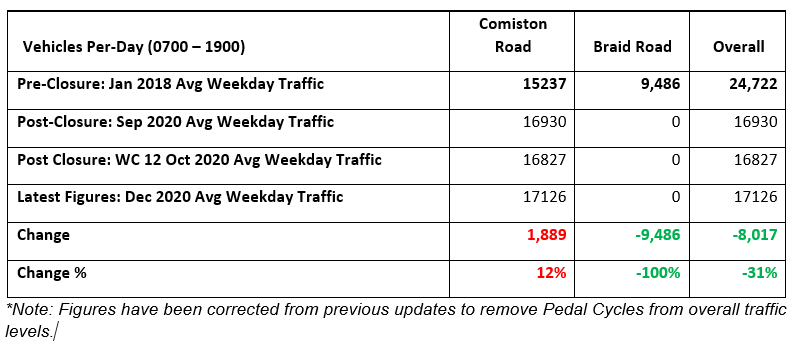
Traffic Counts have been carried out on Comiston Road at the junction with Greenbank Crescent. These have been compared with baseline counts from 2018 and results are shown in the table below.
Traffic on Comiston Road is currently around 9.5% higher than the pre-Covid baseline – around 17,000 vehicles per day, compared with 15,500 vehicles per day – the increase on the A702 corridor is far smaller than the amount of traffic previously recorded using Braid Road – 9,486 vehicles per day.
The overall level of traffic on these two corridors is significantly less than pre-Covid levels (approx. 32% less on these two routes). The general level of traffic which has returned to these corridors (68% of pre-Covid) is less than the general level across the city (80 – 90%), suggesting the closure has achieved a level of traffic reduction on this route. Though it is possible traffic has moved to other routes in the surrounding area.
Air Quality
Concerns have been raised regarding the impact of the Braid Road closure on air quality on the A702, especially on Comiston Road between Greenbank Crescent and Morningside Station. There are two diffusion tube monitoring stations in the area, one at South Morningside Primary School (116 Comiston Rd) and the other further north at the Canny Mans Pub (Morningside Rd). Results from June to October 2020 period, varied between 10-20μg/m3 of Nitrogen Dioxide, which is both lower than the previous year and significantly lower than EU legal limits. This is shown in the graph below.
It is worth noting that these are uncorrected monthly recordings. Normally annual measurements are used for comparison, however these will not be available until later in 2021.
The monthly measurements suggest the closure of Braid Road has not led to poorer air quality on the A702.

Bus Journeys on the A702
The Council has liaised closely with Lothian Buses on a regular basis to determine the impact of the Braid Road closure on A702 bus routes. Lothian Buses have noted that delays have been minimal since the week of August 10th however, in mid -December southbound delays increased as shown in the graph below.

Lothian Buses have noted that traffic routing through residential streets (Cluny Drive to Comiston Road etc) are feeding on to Comiston Road impacting journey times at peak times.
Lothian Buses have expressed support to re-open Braid Road to Southbound traffic to reduce the amount of traffic emerging on to the A702 from side roads between Morningside Station and Greenbank Crossroads. Alternatively, the introduction or additional measure to reduce through traffic from the residential roads between Cluny Drive and Comiston Road could be considered.
Level of Cycle use
Cycle counts were carried out on Braid Road shortly after the closure between Thursday 7 May and Wednesday 13 May 2020. During this time an average of 579 cycle journeys used Braid Road each day. Unfortunately, pre-lockdown counts are not available, however, anecdotal evidence suggests that cycle and pedestrian numbers are still significant, even during the winter period, compared to pre-lockdown levels. The most recent count was undertaken between Thursday 10th and Friday 11th December 2020, indicating an average of 168 cycle journeys on Braid Road each day.
Conclusion
Traffic levels at Greenbank Crossroads remain fairly static at around 17,000vpd, and evidence suggests there has been no negative impact on Air Quality on the A702, southbound bus delays were recorded in mid-December 2020.
Journey times will continue to be monitored in early 2021.
The country is now in a stricter lockdown period and traffic levels across the city have again fallen. Lothian Buses have advised journey times on the A702 routes have returned to normal. However, when the current lockdown eases we may see delays return as traffic levels increase.
Finally, the recommendation offered to the Transport and Environment Committee is to reopen this route in a southbound direction to mitigate the negative impact of traffic and public transport delays and reduce the level of intrusive traffic using residential streets including Cluny Drive and Braid Crescent etc.
It is known that re-opening Braid Road would reintroduce additional traffic into the area. The volume of traffic returning to Braid Road would likely be greater than the corresponding decrease in traffic on Comiston Road. However, there is also a risk that as traffic across the city returns to normal, the level of traffic on Comiston Road will continue to grow in 2021, with likely negative outcomes for public transport journey times and air quality.
At the time of completing this briefing the decision to reopen Braid Road is still to be made, the final timing and layout of the proposed Braid Road reopening is still to be finalised.


 Dr Scott Arthur